
The One Big Beautiful Bill Act (OBBBA), the reconciliation bill recently passed by the House of Representatives and now being discussed and reworked in the U.S. Senate, has three main components: (1) It contains funding for the strongest border security in U.S. history including the entire wall at the southern border; (2) it fully extends the enormously successful 2017 tax rate cuts and (3) it provides the most significant welfare reform in 30 years.
Reconciliation versus Rescission
Elon Musk has recently expressed his disdain for OBBBA as he believes it has ignored the approximately $175 billion in federal spending that DOGE (Department of Government Efficiency) had earmarked for elimination. But 95% of DOGE recommendations cannot be included in a so-called “reconciliation” bill.
The reconciliation process is a tool that small majorities in Congress often use to pass very narrowly defined legislation. To qualify for this process, a bill can only cut mandatory (not discretionary) federal spending, enact revenue changes (like tax rates) and/or alter the federal debt limit.
The “elephant in the room” or the Capitol in this case is the looming expiration (December 31, 2025) of the tax rate cuts of the Tax Cut and Jobs Act (TCJA) of 2017. Keeping these lower rates in effect and avoiding the potential economic calamity if they terminate is, and should be, Congress’s number one priority.
If OBBBA skipped the reconciliation process and was just another appropriation’s bill it could be permanently killed due to Senate rules. The bill would likely be stalled by a filibuster that could go on indefinitely because 60 votes are required for “cloture” or invoking the process that pushes the filibuster to an end within 30 hours. Given the Republicans slim 53-47 vote majority in the Senate, there is no way they could convince at least seven Democrats to go along with keeping tax rates essentially the same as they have been for the past nine years.
So at least temporarily, ignoring DOGE recommendations by using the reconciliation process for the tax rate issue was a necessity. There was no other feasible option.
The Impoundment Control Act of 1974 (ICA) requires the President to defer federal funding decisions to Congress. But the ICA also gives only the President the right to specifically identify already appropriated but unspent funds, ask Congress to eliminate them, and also have his request expedited. This “rescission” bill then bypasses any possibility of a Senate filibuster, meaning just a simple majority vote is needed to approve it rather than a 60 vote plurality.
Congress can also initiate rescissions on its own, but those not proposed by the President do not qualify for the expedited process. The expedited process can only commence with Presidential action.
The President sends his rescission bill to Congress which can then act (within 45 days) or, as it has done in the past, ignore his request.
Even though OBBBA at this writing is still being discussed in the Senate, President Trump has already submitted his initial $9.4 billion rescission package to Congress for expedited approval. This would remove as much as $8.3 billion from USAID for non-emergency assistance programs and $1.1 billion from the Corporation for Public Broadcasting (including National Public Radio).
Congressional Budget Office (CBO) “Scoring”
The unpublished motto for the Congressional Budget Office (CBO) and the Joint Committee on Taxation (JCT) ought to be Yogi Berra’s famous quote: “It’s tough to make predictions, especially about the future.”
The CBO and JCT are publicly considered non-partisan and are almost exclusively relied upon to “score” or predict future economic actively as measure by Gross Domestic Product (GDP) along with all future federal revenue and spending amounts.
It’s difficult to overstate the tremendous power and influence they wield in Washington, D.C.
And yet, they are nearly always wrong.
To be fair, that they are inaccurate is not a surprise as making such predictions is an enormously difficult task. What is more concerning however, given how important their forecasts are for bills like OBBBA, is that they are routinely wrong — just one way.
The CBO always underestimates the revenue received from a tax rate cut and always overestimates revenue from a tax rate increase. Obviously for OBBBA, which deals with tax rate decreases, this is a major problem.
Nearly 30 years ago I had a friendly debate with the vice-chair of the Federal Reserve Board on the riveting topic of dynamic versus static economic analysis. At the time I was serving as chairman of the former Small Business and Agriculture Council of the Philadelphia Federal Reserve Bank. I argued that so-called “static analysis” used then almost exclusively by the CBO to score tax rate reductions was always wrong because it failed to take into account real world behavior. Eventually the vice-chair admitted that politics pay an important role in the process.
There are many examples of CBO’s bias.
Just before President Trump took office in 2017, the CBO predicted that two million jobs would be created during the next two years. However, after the 2017 TCJA was passed and economic activity stimulated, seven million new jobs were created by December 2019.
Even including the disastrous COVID-19 year of 2020, CBO’s prediction of revenue after 2017 through the end of fiscal 2024 has been underestimated by $1.5 trillion or about $250 billion per year.
CBO’s poor predictions helped pass President Biden’s so-called Inflation Reduction Act. This was essentially the “Green New Deal” packaged under a deceptive name. It predicted or “scored” total Green handouts to cost $271 billion. But just six months later — after the bill had become law — CBO revised its cost estimates more than 2½ times that amount to $663 billion. Other outside organizations have predicted that these grants will cost the American taxpayer well over $1 trillion.
Here’s another example of how the CBO’s scoring of the Inflation Reduction Act way over estimated its positive effect on the deficit. It initially predicted the law would actually reduce the deficit by $58 billion over 10 years.
In 2024 it updated that prediction well after the bill had been passed into law. No longer would there by any deficit reduction. Now it said the deficit would be increased by $300 billion over the next decade.
Perhaps the most aggravating but laughable prediction was the Biden administration’s goal of providing the IRS an added $80 billion for additional agents. This amount was eventually reduced to $58 billion by Congress. CBO predicted the additional funds and anticipated enforcement actions producing increased collections would reduce the deficit over 10 years by $180 billion.
As of the end of FY2024, 4,000 new agents had been hired but only $1.3 billion in additional revenue had been collected. This is 82% below the CBO’s predicted amount of $7.2 billion by this point.
Predictions aside, the revenue generated by those 4,000 agents should have at least covered their actual employment cost. Amazingly however, for every additional dollar collected, the new agents cost the American taxpayer $1.04.
Washington score keeping is always skewed toward benefiting the Deep State. This tax bill is a great example. It states that keeping today’s tax rates essentially the same will cost the government money. It can’t cost them anything because the money was never theirs to start with.
The non-partisan Tax Foundation likely scores the (OBBBA) bill more realistically. It predicts GDP would be increased by 0.8% and the overall increase to the deficit would be $1.725 trillion using dynamic scoring but before additional interest costs.
Regardless of knowing the CBO ‘s poor prediction track record, for the purposes of this major legislation, what they say becomes gospel. Thus a major problem for Senate approval is CBO’s estimate that the bill would add $3.8 trillion to the deficit over 10 years.
The 2017 Trump tax cuts produced the lowest poverty rate in U.S. history – including all-time lows in unemployment for African American and Hispanic workers and those without a college degree.
The 2017 Trump tax cuts produced the lowest poverty rate in U.S. history – including all-time lows in unemployment for African American and Hispanic workers and those without a college degree.
If Democrats get their wishes and the 2017 tax rate cuts are allowed to expire, the federal government will be extracting an additional $4.6 trillion from its citizens to support its drunken spending addiction. The result will be weaker economic growth, lower private investment and a lower standard of living for the great majority of Americans.
Tax Rate “Cuts”
The Tax Cut and Jobs Act of 2017 (TCJA) cut tax rates across the board with the top rate being trimmed from 39.6% to 37%. Democrats demonized the law as a huge tax cut for millionaires and billionaires with no relief for workers. This article will show that allegation was unfounded.
The greatest flaw in the law is that it was temporary. It will expire at the end of this year. Beginning in January tax rates, on average, will rise 22% according to the House Ways and Means Committee.
In order to justify higher tax rate increases, Democrats use a tried and true mantra: The rich are not paying their fair share. They likely know they do of course, but the lifeblood of their party is government spending. And with our national debt now over $36 trillion, they’ll try to get every dollar they can into Washington.
The Organization for Economic Cooperation and Development (OECD) data (before the 2017 tax cuts) show that “the United States has the most progressive income tax system in the world, with the top 10% of earners paying 45% of all income taxes, including Social Security and Medicare taxes, compared with only 28% in France and 27% in Sweden.”
This means that the highest earners in the U.S. more than pay their “fair share” taking a much larger portion of the total tax burden than their counterparts in the OECD countries.
Perhaps surprisingly to many, especially those who bought into the erroneous notion that the 2017 Trump tax rate cuts were nothing more than a tax cut for billionaires, our tax system became even more “progressive” after they went into effect. The highest earners paid a greater portion of the tax burden.
… the highest earners in the U.S. more than pay their “fair share” taking a much larger portion of the total tax burden than their counterparts in the OECD countries.
In 2016, the year before the tax cuts were enacted, the top 1% of earners paid (still an astonishing) 37.3% of the total income tax bill. The top 10% paid 69.5%. By 2022 (the most recent year with available data), the top 1% saw its share rise to 40.4% and the highest 10% to 72.0%. (See chart)
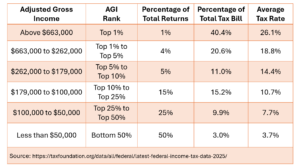
So if Democrats (not one House Democrat voted to keep tax rates the same) get their way and the tax code reverts to the old rates, they ironically will see the wealthiest taxpayers go back to paying less of the total tax bill like they did in 2016. The rich are rich for a reason and will again make greater use of tax avoidance strategies.
One of the main sticking points in OBBBA for a number of House Republicans from “blue” states was the SALT cap. The SALT (acronym for State and Local Taxes) deduction was capped at $10,000 by the 2017 TCJA. Democrats from high tax states (e.g., New York’s top rate is 10.9%, NY City’s top rate is 3.88%) like Senator Chuck Schumer have said that restoring the SALT deduction is their top tax provision target.
He is not alone. Many Republican House members pushed Speaker Mike Johnson for a much higher SALT deduction or they would withhold their votes. With a razor thin majority, Johnson had no choice but to yield to their demands.
In the House version of OBBBA, the SALT deduction has, unfortunately, been increased to $40,000. This effectively forces taxpayers from low tax states to subsidize the high tax-and-spend states like New York and California.
Ironically, one of the biggest opponents of this significant SALT deduction is Sen. Bernie Sanders (I-Vt). Of course, Sanders hates any tax breaks that he believes benefits the high income earners. And the SALT deduction is certainly one of them.
The Tax Policy Center has calculated that earners making over $1 million a year would enjoy more than half of the entire SALT benefit though they make up less than 1% of all tax returns.
The other issue regarding raising the SALT deduction from $10,000 to $40,000 is the revenue problem. Various estimates put the loss to the federal treasury over the next ten years anywhere from $320 billion to $350 billion. The Senate may not be as kind to the millionaire earners in these Democrat-run states.
The Tax Policy Center has calculated that earners making over $1 million a year would enjoy more than half of the entire SALT benefit though they make up less than 1% of all tax returns.
Not surprisingly when international corporations consider expansion, they take into account a number of factors as they evaluate the countries where their company would fare best. Things like a nation’s political stability, quantity and especially the quality of available workers, desirability of living conditions — and of course, corporate tax rates.
For the first times in decades the U.S. is competitive with the OECD (average of 23.7%) and European Union (21%) in the tax rate it imposes on its corporations.
The result of the competitive rate was that inflation-adjusted earnings for workers increased 9% from Jan 1, 2018 when the law took effect to Dec. 31, 2020. It was the fastest growth since 1979 when the government first began to publish these data.
Since corporations don’t truly pay taxes anyway — they collect them through higher prices or reduced potential wages for their workers — it would a grave mistake to raise the corporate tax rate especially since the lower rate has produced considerably more revenue. The eight years from 2016 to 2024 saw corporate income tax revenue increase by 76.9% as companies spent less time and effort on tax avoidance strategies.
The top 1% of income earners (those with adjusted gross income over $663,164 as of 2022), the very rich, earn 22% of all AGI but pay 40% of the entire income tax bill.
If the TCJA expires (not replaced by OBBBA) it would be devastating for workers. The U.S. Treasury Department’s research says if corporate rates were raised back to 28%, it would amount to a $500 billion tax increase on families earning less than $300,000 annually.op 1% of income earners (those with adjusted gross income over $663,164 as of 2022), the very rich, earn 22% of all AGI but pay 40% of the entire income tax bill.
Here are bullet points with some surprising statistics based in 2022 IRS data:
- 50% of the country carries the other 50%. Half of the tax return filers pay 97% of the total tax bill; the other half pays just 3%.
- The top 25% of taxpayers, those households with Adjusted Gross Income (AGI) above $100,000 pay 87.2% of the total tax bill. Conversely all those earning less than $100k or 75% of tax return filers pay 12.8% of the tax bill.
- The top 1% of income earners (those with adjusted gross income over $663,164 as of 2022), the very rich, earn 22% of all AGI but pay 40% of the entire income tax bill.
- The top 10% of income earners (incomes (AGI over $178,611) earn 49.4% of AGI but pay 72% of the total tax bill.
(There are likely many two-earner married couples who file joint returns who are surprised to learn that they are among the “rich” who are routinely demonized.)
The stated tax rate of 3.7% for the bottom 50 of income earners is overstated. Most of these (77 million) households have no tax liability at all due to refundable tax credits. For many, the credits give them a negative tax rate, meaning they receive a (welfare) check from Uncle Sam.
The top 10% of income earners (incomes (AGI over $178,611) earn 49.4% of AGI but pay 72% of the total tax bill.
According to the House Ways and Means Committee the average household will see an increase in taxes of 22% if the TCJA expires. A family of four earning median income of $80,610 would see a tax hike of $1,695.
An incredibly high 40 million families will find that their Child Tax Credit has been cut in half. Approximately 90% of all taxpayers will see their Guaranteed Deduction sliced in half.
Other provisions of OBBBA will likely be quite popular with seniors (no income taxes on Social Security benefits), hourly workers (no tax on overtime through 2028) and service workers (no tax on qualified tips).
Even with some baggage, continuation of the 2017 tax reform law is essential. That means the passage of One Big Beautiful Bill Act. The TCJA did what its proponents said it would: All income groups saw their tax rates reduced and the highest earners absorbed a higher percentage of the total tax bill.
According to the House Ways and Means Committee the average household will see an increase in taxes of 22% if the TCJA expires. A family of four earning median income of $80,610 would see a tax hike of $1,695.
TCJA delivered the greatest benefit to middle-income earners. Combined with a reduction in the corporate tax rate, it energized economic growth and reduced poverty. Its latest version needs to become law.
Mandatory Spending Cuts
Given that a reconciliation bill like OBBBA can only deal with mandatory spending (not DOGE recommended DISCRETIONARY cuts), the clear target had to be Medicaid spending since Medicare and Social Security and were off the table for consideration.
Medicaid, the federal program designed to provide medical assistance for the impoverished, especially children, has grown out of control. The Center for Medicare and Medicaid Services (CMS) reported that the number of residents (including many non-citizens) enrolled in Medicaid grew from less than 40 million in 2002 to approximately 92 million by 2022. That is more than one out of four in America.
Medicaid, a program originally intended for impoverished women and children, is an unusual program in that none of the $618 billion spent on the program last year were actually received by the poor. To be sure they received services, but all those Medicaid dollars likely flowed to wealthy hospital systems, assisted care facilities and physicians.
The cost of the program has more than doubled in the past ten years: From $302 billion in 2014 to and unsustainable $618 billion in 2024. With or without OBBBA something had to be done to reign in this program before it imploded.
The proposed changes are reminiscent of Bill Clinton’s welfare cuts back in the mid-nineties. No longer will able-bodied adults still in their working years without dependents receive Medicaid benefits without working or volunteering at least half-time or 80 hours each month.
Also, for those who earn more than the federal poverty level there will be co-pays up to $35.15 that the individual states will determine for certain medical procedures.
States that have enrolled people living here illegally will pay a penalty for that “generosity” at the expense of the American taxpayer. Federal reimbursements for those who signed up under the Affordable Care Act will decline from 90% to 80%.
It is important to fully understand what this means. Federal dollars will still be paying 80% of Medicaid costs for illegal immigrants who have been enrolled under Obamacare.
The CBO projects these changes would reduce the deficit by more than $715 billion by 2034 but increase the number of uninsured by 7.7 million.
This increase in the uninsured would be mitigated by some employers again providing health insurance for their employees. Also, it is important to remember that no one with a critical medical issue requiring emergency care is denied treatment by any hospital in America as a result of the Emergency Medical Treatment and Labor Act of 1986. This requires hospitals to treat and stabilize patients regardless of their ability to pay.
The other major “mandatory” cost savings will be changes to the Supplemental Nutrition Assistance Program or SNAP. This is more commonly referred to as food stamps.
The program costs the federal government about $113 billion/year and provides food assistance to 42 million people.
Currently the federal government picks up the tab for 100% of these benefits. The OBBBA would reduce this to 95%, thereby transferring the other 5% to the states where it would likely be administered more closely.
There are presently no work requirements for able-bodied adults aged 54 or older. The changes would raise this age limit to 64. It would also increase the states’ share of administrative costs from 50% to 75%. Those living in the U.S. illegally would not be eligible to receive the benefit.
The CBO says these changes to SNAP would reduce the deficit by $230 billion between 2025 and 2034.
The White House maintains that the sum of these proposed spending cuts will total $2 trillion which would make them likely the largest reductions in the history of the republic.
Other Key Components of OBBBA
There are also spending increases in OBBBA. These are exclusively for national defense.
One of the key spending additions included in OBBBA is a $150 billion overall boost for defense: $34 billion for new shipbuilding, $21 billion for depleted weapons’ inventory, $13 billion for nuclear weapons modernization, $400 million for development of the next generation stealth fighter, the F-47 and $25 billion as a down payment on President Trump’s pet “Golden Dome” missile defense initiative that he estimates would totally cost $175 billion and take three years to complete.
Regarding border security, the bill will fund 3,000 new Border Patrol agents, 5,000 new customs officers including retention bonuses, and 10,000 new Immigration and Customs Enforcement (ICE) officers ($6.1 billion).
The southern border wall would be fully funded by an allocation of $50 billion.
As an offsetting measure, the House Oversight Committee has secured $51 billion in deficit reduction by requiring federal workers hired before 2014 to contribute 4.4% of salary to their pensions. It brings them in line with those hired after 2014.
The upside-down accounting of Washington D.C. considers maintaining current tax rates and credits after December 31, 2025 as costs to the federal government. So Americans not being subjected to a huge tax increase is deemed a major cost to the government.
It likely didn’t help Elon Musk’s impression of the bill when he learned that Biden’s clean energy tax credits along with other green energy tax subsidies would be phased out. Nuclear power plant construction, however, benefits from rule changes that make it eligible for tax credits when construction begins rather than when it enters production.
Finally, the contentious federal debt limit would be increased another $4 trillion, moving it beyond next year’s mid-term elections. This is a major deal for a number of senators but they know one way or another, Washington is not close to producing a balanced budget which is what it will take not to increase the federal debt.
* * *
The upside-down accounting of Washington D.C. considers maintaining current tax rates and credits after December 31, 2025 as costs to the federal government. So Americans not being subjected to a huge tax increase is deemed a major cost to the government.
In any event and even though this bill is not necessarily “beautiful,” it is good. Its rejection can’t be permitted to occur. It would be devastating for working families and the national economy.
Additionally, after four years of open borders where perhaps as many as 8-10 million illegal immigrants have likely brought the total number to 20-30 million, border control and enforcement is urgent.
The proposed changes to Medicaid and SNAP are actually quite modest when the enormity of out-of-control federal spending is considered. For the first 8 months of this fiscal year that began on October 1, 2024, our federal government has spent $3.9 million every minute — that we don’t have! (This is actually an improvement from the last three months of the Biden administration when we spent $90,000 per second or $5.4 million each minute.)
Last year we sent Washington enough money that would have produced a $500 billion surplus as recently as 2019.
The reality is that the tax component of the OBBBA will not add a dollar to the deficit. It won’t reduce individual tax revenue at all from current levels.
Revenue is not our problem. Individual income tax revenue is 57% higher than it was before the 2017 tax rate cuts!
Last year we sent Washington enough money that would have produced a $500 billion surplus as recently as 2019.
Spending is the problem. Joe Biden spent 75% more in his final year in office than Barack Obama did in his final year. 75%!
The One Big Beautiful Bill is not perfect. The compromises — some of which have been quite harmful like the increase in SALT deduction — have been frustrating. With a number of so-called moderate Republicans using their clout due to a razor thin majority with no Democrat support whatsoever, the bill is less than it could have been.
We hope (gulp) that House Republicans will be encouraged by the passing of this bill to immediately go after the DOGE recommended cuts as it tackles an appropriation package. With contentious issues like taxes, border control and the debt limit off the table however, Democrats will have a harder arguing against more spending cuts.
The ten year forecast of OBBBA adding to the national debt ranges between $1.725 trillion (Tax Foundation) and $3.8 trillion (CBO). Even without these additions,CBO has forecasted the debt to rise by $21.8 trillion!
This means that if Congress doesn’t pass OBBBA and our tax rates increase by 22%, the federal debt will still rise by nearly $22 trillion to approach $58 trillion in total. Let people live their lives, pass this bill and then make a real effort to cut spending. DOGE has pointed the way.
In the meantime and before we get ahead of ourselves, hopefully the Senate Republicans will produce a stronger bill that the House can still support and get it to the President by July 4. It must pass.
